The Silent Problem Slowing Down Growing Mental Health Practices
What Happens When Your Practice Actually Communicates With Itself
There’s a point every mental health practice owner reaches that sounds like this:
Why does everything feel harder than it should be?
Your practice is growing.
You have demand.
You have a team.
You’re doing meaningful, important work.
And yet, what should be considered success, feels scattered.
We see it all the time at MFVA.
You’re checking multiple places to answer simple questions.
Your team is asking for clarification on things you know you’ve already explained.
Intake feels busier than ever—but you don’t know how or why.
And you have this lingering sense that something is slipping through the cracks… even if you can’t quite prove it.
The Silent Problem in Growing Mental Health Practices
Most therapy practices don’t break down because of poor clinical care.
They struggle because of operational fragmentation.
Information lives in too many places:
A spreadsheet tracking intake
An email thread with updated clinician availability
Notes in your EHR
A Slack message with a policy change
A document someone created months ago—”Is this the current document? No, the current document is in the new folder.”
And a whole lot of “just ask me if you need it”
Individually, each of these systems feels manageable.
But together?
They get more chaotic as you grow.
And chaos is expensive.
What Disconnected Systems Actually Cost You
1. Lost Revenue You Can’t See
When your systems don’t communicate, your intake process weakens.
Not dramatically. Not all at once.
But in small, consistent ways:
A missed follow-up
A delayed response
A mismatch between client and clinician
A referral that isn’t tracked
A voicemail that doesn’t get documented properly
Each one feels minor.
Until you zoom out.
If your practice receives 30–50 inquiries per month and even a handful don’t convert due to operational gaps, you could be losing:
$50,000 to $150,000+ per year in potential revenue.
Not because you’re not good at what you do.
But because your systems aren’t built to support your growth.
2. The Mental Load of “Holding It All Together”
This is the part no one talks about enough.
When your systems are fragmented, you become the system.
You are the one who:
remembers how things are supposed to work
fills in the gaps when information is missing
double-checks things “just in case”
answers the same questions over and over
carries the mental map of your entire operation
Even with a team, it can feel like everything still runs through you.
And that creates a constant, low-level pressure that sounds like:
“If I don’t stay on top of everything, something will fall apart.”
That’s not a sustainable business.
That’s operating in survival mode and that leads to burnout.
3. Team Inefficiency (Even With Great People)
You can have an incredible team—and still struggle with efficiency.
Why?
Because your team can only perform as well as the systems supporting them.
When information is scattered:
They spend time searching instead of executing
They hesitate because they’re unsure
They rely on you for answers
They duplicate work without realizing it
And over time, this leads to:
slower operations
inconsistent client experiences
frustration on both sides
Your team is capable but your practice doesn’t have a central hub for your daily operations.
4. Limited Visibility Into Your Own Practice
You feel like your practice is busy.
But you don’t always know:
How many inquiries are we actually getting?
Where are they coming from?
What percentage are converting?
Which clinicians are filling fastest?
Where are we losing people in the process?
That information exists.
But it’s buried across systems that don’t talk to each other.
So instead, you’re left making decisions based on:
intuition
partial data
or delayed insights
And when you’re trying to grow a business, that lack of visibility matters.
Why This Happens (And Why It’s Not Your Fault)
Mental health practice owners are rarely trained in operations.
You were trained to:
diagnose
treat
support
care
Not to build systems for:
intake tracking
workflow management
data visibility
team coordination
So most practices evolve organically.
You build what you need when you need it.
A spreadsheet here.
A process there.
A workaround that becomes permanent.
And for a while, it works.
Until it doesn’t.
Until your practice reaches a level of growth that your systems weren’t designed to support.
What Happens When Your Practice Does Communicate With Itself
Now let’s flip the scenario.
What happens when everything lives in one place?
When your intake, workflows, clinician information, and contact tracking are connected?
When your practice actually communicates with itself?
Everything changes.
1. Intake Becomes Clear and Trackable
Every inquiry—no matter how it comes in—is captured.
Calls
Emails
Web forms
Texts
Referrals
Instead of scattered notes, you have a complete contact log. Every inquiry is tracked so no matter how someone communicates with your practice they get the same care and attention before and after their sessions.
You can see:
when someone reached out
who responded
what happened next
whether they scheduled
who completed each intake step and when
No guessing. No digging.
Complete, real-time transparency into your day-to-day operations.
2. Matching Clients to Clinicians Gets Easier (and Better)
Instead of relying on memory or incomplete information, your team has access to:
specialties
credentials
insurance participation
availability
location
All in one place.
That means:
better matches
more confident intake decisions
improved client experience from the very first interaction
3. Your Workflows Actually Work
Instead of living in someone’s head or buried in a checklist, your processes become visible and trackable.
With customizable workflow boards:
tasks are clearly assigned
progress is visible
nothing gets lost
You can see at a glance:
what’s active
what’s complete
what needs attention
And for the first time, your practice starts to feel… organized.
4. You Gain True Visibility Into Your Practice
When your systems are connected, your data becomes meaningful.
You can finally see:
inquiry volume
conversion rates
referral sources
peak contact times
clinician caseload trends
This is where your practice shifts from:
“I think things are going well…”
to
“I know exactly what’s happening.”
5. Your Team Becomes More Independent (and Effective)
When everything is organized in one place:
your team knows where to look
they trust the information they’re using
they don’t need to rely on you for every answer
Which means:
You can stop being the bottleneck.
And start being the leader your practice actually needs.
The Shift: From Patchwork Systems to One Operational Brain
At some point, every growing practice faces a decision:
Keep patching together systems…
Or build something that actually supports where you’re going.
This is the shift from:
reactive → proactive
scattered → structured
overwhelmed → in control
Introducing a Better Way: TheraBrain™
After years of working inside thousands of mental health practices, we saw this challenge over and over again.
And we realized something important:
This wasn’t a people problem.
It was a systems problem.
So we built TheraBrain™.
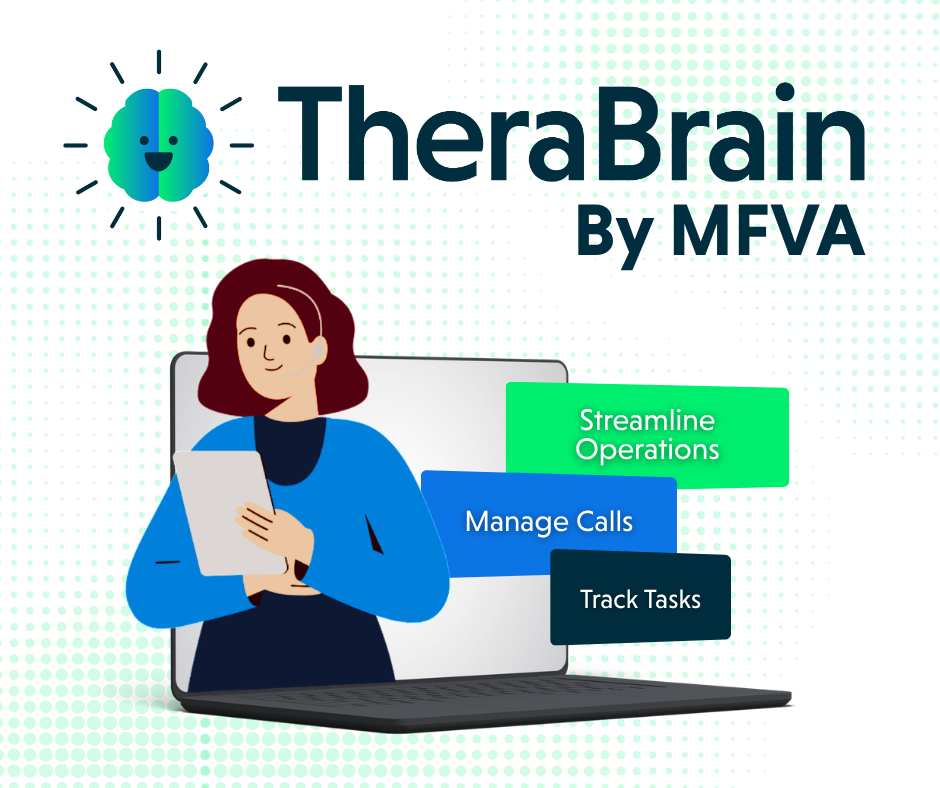
TheraBrain is the central nervous system your practice—bringing together the information, workflows, people, and insights that help your practice run smoothly and scale with ease.
What Makes TheraBrain Different
We built TheraBrain™ to be the single source of truth for your practice by being a unified operations platform that supports both human and workflow-based systems.
Customizable workflows that track every step of your processes
Comprehensive practice information your team can rely on
Clinician matching tools for confident intake decisions
A comprehensive, searchable contact log tied directly to workflow boards
Task tracking with attribution, so you know exactly who did what
A 2 Factor password management system so you and your support team can work together with ease.
Data analytics so you can make informed decisions for your practice.
Internal conversation tools keep communication focused and easily followed.
Every action is visible.
Every update is trackable.
Every part of your operation is connected.
Transparency You’ve Never Had Before
For the first time, you can see:
what’s happening in real time
where things are moving
where things might be stuck
This is the kind of visibility that allows you to:
lead with confidence
support your team effectively
and grow your practice with data and efficiency
The Future of Your Practice
You didn’t build your practice just to survive.
You built it to:
make an impact
serve your community
create something meaningful
and yes—build a business that supports your financial and lifestyle goals
That requires more than great clinical work.
It requires systems that support your bigger vision.
TheraBrain was built with that vision in mind and we can’t wait to show you what it can do.
Want to see how TheraBrain can transform your therapy practice?